Monday 13 / July / 2026
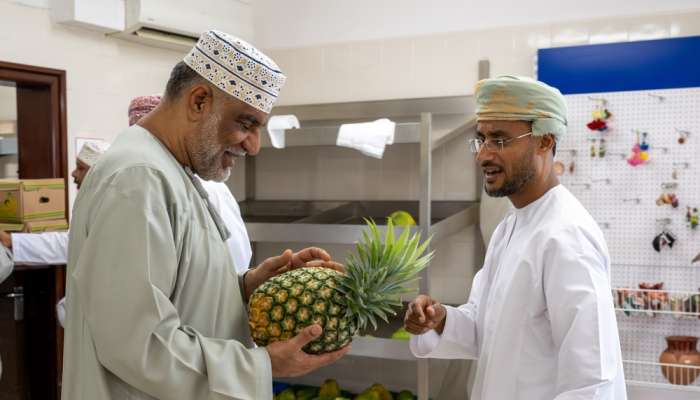
Muscat :After nearly fifteen years of dedicated research and agronomic trials, Razat Royal Farm, operating under the Royal Court Affairs, has successfully produced pineapples on home soil. The initiative set out to determine whether Oman’s local environment could support a crop with strong economic and nutritional promise.
At Razat Farm in Dhofar Governorate, cultivation methods evolved from small‑scale container experiments to extensive field planting under tree shade and within controlled greenhouse environments. The crop has adapted remarkably well to Dhofar's climate, with the growing season running from July through December—a period that offers mild temperatures and high humidity during the annual Khareef (monsoon) season.
Vegetative growth reaches full development after about six months, while the fruit matures for harvest roughly twelve months after planting, when the lower portion turns a distinctive golden-yellow.
Eng. Suhail Said Al Mashani, Senior Agricultural Engineering Specialist at the farm, described the project as a landmark achievement. He added: “Growing pineapples at Razat Royal Farm is a pioneering success in Omani agriculture. We have trialed several varieties—Queen, Mauritius, and MD‑2—with the latter now emerging as the most commercially viable worldwide. MD‑2 produces large fruits weighing anywhere from two to over four kilograms, combining exceptional sweetness with strong market appeal.”
He also highlighted the crop's efficient water usage, noting that it requires significantly less irrigation than many other tropical species. Crucially, tissue‑culture techniques have been instrumental in supplying large numbers of uniform, disease‑free seedlings—a factor that not only underpinned the project's success but also positions the farm for future large‑scale expansion.
This achievement represents more than just a new crop for Oman. It strengthens agricultural diversification, reinforces the value of climate‑ and soil‑aware farming, and demonstrates the power of meticulous scientific observation. Above all, it opens the door to explore other non-traditional high-value crops across the Sultanate of Oman.