Tuesday 20 / January / 2026
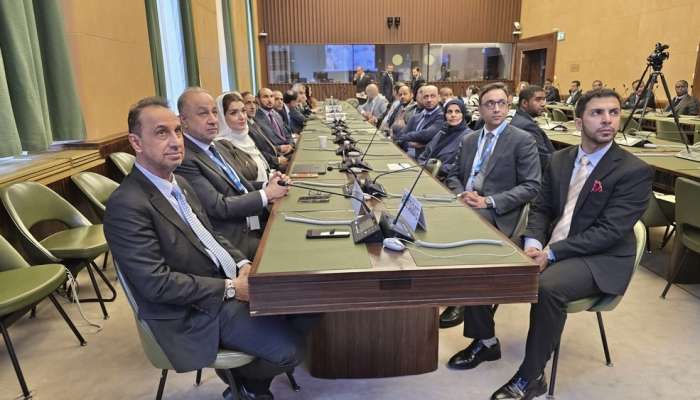
Geneva: Oman Human Rights Commission (OHRC) organised a side event at the Palais des Nations in Geneva to showcase the Omani experience, highlight its roles in promoting and protecting human rights, open horizons for dialogue with international partners, and exchange best practices with international institutions and bodies concerned with human rights.
The event was organised in cooperation with the Permanent Mission of the Sultanate of Oman to the United Nations and other International Organisations in Geneva. It aimed to highlight the Commission’s institutional role, enhance international cooperation, and exchange expertise. It also presented the features of the Commission’s experience and priorities, provided a concise and reliable overview of its work, and highlighted national efforts in various fields—including labour rights—while introducing the Commission’s awareness programmes and tools.
The event targeted a wide range of stakeholders in Geneva, including diplomatic missions accredited to the UN, international organisations, relevant UN agencies, National Human Rights Institutions (NHRIs), civil society organisations, and human rights enthusiasts, as well as researchers and media professionals.
The event featured three specialised working papers. The first paper addressed "Business and Human Rights" as a growing field linking economic development with human rights standards, highlighting the Commission's methodology through assessment tools, recommendations, and follow-up, and reviewing its qualitative initiatives, such as the preparation of guiding manuals.
The second paper focused on the promotion and protection of labor rights through field monitoring of working conditions, housing, and occupational safety, as well as mechanisms for receiving, verifying, and following up on complaints with competent authorities.
The third paper presented an overview of parallel reports and awareness programs, explaining the methodology for preparing shadow reports in accordance with UN guidelines and the importance of these reports in enhancing transparency and expanding international participation and cooperation in human rights files.
On the sidelines of the event, the OHRC held an introductory exhibition of its publications, showcasing a range of specialised prints and awareness materials, printed annual reports, and various human rights manuals and booklets. Attendees were introduced to the Commission’s experience in printed publications and its reporting methodology.
Dr. Rashid Hamad Al Balushi, Chairman of Oman Human Rights Commission, emphasised that the Sultanate of Oman—with its historical depth and influential geographical location—believes that true stability is only achieved through the rule of law and the safeguarding of human rights. He reviewed the Commission’s journey since its establishment in 2008 by Royal Decree, followed by its transition to a qualitative development phase with its reorganisation under Royal Decree No. 57/2022. This decree solidified the framework governing its work and defined its formation, decision-making mechanisms, and competencies in a manner that supports and enhances institutional independence.
The Chairman explained that the system includes clear provisions regulating the purpose of the Commission’s establishment, the mechanism for electing the chairman and deputy, membership terms, and meeting procedures to ensure regularity and efficiency, precisely outlining the competencies entrusted to the Commission according to its national responsibilities.
In his speech, he highlighted the "Accessibility of the Institution to the People" as one of the most important indicators of the maturity of NHRIs. He noted that the Commission has developed a system for receiving reports and complaints and introduced multiple channels ensuring access for various groups while maintaining privacy and procedural clarity.
He stated that in recent years, the Commission has begun receiving, monitoring, and dealing with more than 1,000 reports annually. He considered this an indicator of the volume of work on one hand, and of rising community trust in national mechanisms and growing awareness that rights are protected through specialized institutions on the other.
The Chairman also discussed "Human Rights Indicators" as a scientific tool that transforms values into measurable standards and supports evidence-based policymaking. He noted that specialised workshops were held to produce a human rights indicator manual for Oman, emphasising that the Sultanate of Oman’s presence in the international human rights system has been strengthened, as it is now an active member of 8 out of the 9 core international human rights treaties.