Friday 01 / May / 2026
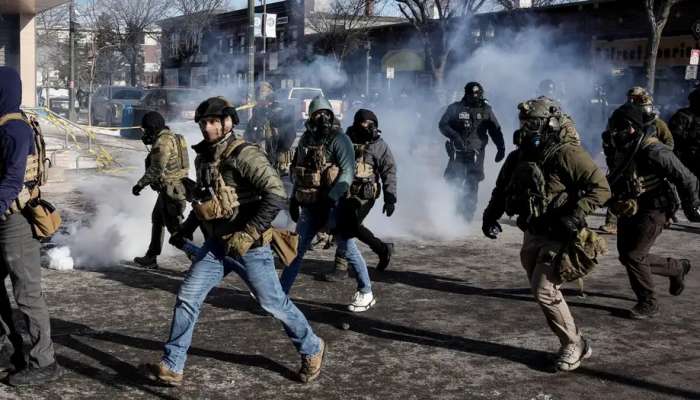
Minneapolis: High-profile, at times lethal and potentially unconstitutional actions by federal US immigration officers could be changing the views of Americans on a cornerstone Donald Trump policy.
Immigration has been a centrepiece of the US president’s platform throughout more than a decade of political life, and was at the core of his 2024 election campaign.
But polls show public opinion has shifted amid the widely circulated operations carried out by Immigration and Customs Enforcement (ICE) officers and other federal agents in urban areas. Those operations have this month seen the shooting deaths of two US citizens in Minneapolis.
A Reuters/Ipsos poll published on Monday local time, drawing responses from both before and after the killing of ICU nurse Alex Pretti, showed 53% of Americans disapprove of Trump’s handling of immigration, compared to 39% on the first day of his new term in January 2025. Approval on his immigration handling is at 39%, down from a high of 50% in February 2025.
Partisanship plays a role still — Republicans were, overall, supportive of ICE’s activities while more than 9 in 10 Democrats disapproved of the measures.
But nearly two thirds of voters who didn’t declare a party of support said ICE's actions had gone too far.
ICE has long been tasked with identifying and apprehending undocumented immigrants, but in Trump’s second term, the agency's activities have been met by protests, public accountability and monitoring campaigns, and heightened tensions on the streets.
It’s a coming together of several factors unprecedented in ICE’s operating history, said Kelsey Norman, director of the Women’s Rights, Human Rights, and Refugees Program at the Baker Institute for Public Policy in the US.
That includes the arrival of ICE officers in major cities, Donald Trump's personal target of one million deportations, a sharp increase of agency funding and officer recruitment, as well as the capturing of violent, and now lethal, conduct by the agency in the streets.
"A lot of these militarised practices have existed within immigration enforcement," Norman told DW, "[It’s] just that they were being deployed in the border where they weren’t necessarily getting the kind of public attention that they are now."
A challenge to America’s deeply held values
The deaths of Renee Good and Alex Pretti have thrown a global spotlight on ICE deployments in US cities. For everyday Americans, the operations highlight other potential risks — not just the potential for lethal force to be used against citizens.
Walter Olson, a senior fellow at the Cato Institute, a US-based libertarian think tank, said there is evidence that ICE's actions are infringing on civil protections under the US Constitution and Bill of Rights.
Olson told DW there have been apparent violations of Fourth Amendment "search and seizure" rights, where ICE has entered homes without judge-signed search warrants. Liberties guaranteed for citizens and non-citizens alike have also been violated, he said.
"We have seen multiple apparent violations of search and seizure rights, including breaking down homeowners' doors," Olson told DW. "In other cases, more numerous, although less dramatic, the constitutional rules for when police can stop you on the street" were violated.
Statements following Pretti’s death by prominent Trump administration officials and supporters have also drawn attention to the Second Amendment, which grants individuals the right to bear arms.
Pretti was a licenced gun owner in the state of Minnesota and authorised to carry a concealed weapon. None of the multiple bystander videos of his killing appear to show him drawing a firearm, yet key administration figures have remarked that Pretti should not have brought a weapon to a protest. This line of reasoning is receiving pushback within the Republican Party and other conservative movements, pointing to constitutional protections.
"Our Second Amendment has been very much treasured by the American conservative side of the spectrum for many decades," Olson said.
"The Trump administration... came out and said things like you should not be carrying a gun on the streets of the city, or you should not ever have a firearm at a demonstration, even if — and I'm going to cite the Minnesota situation — your state allows it, even if you have a license for concealed carry, even if you never use the gun or pull it out or brandish it."
"This is a sharp, 180-degree turn from what the conservative position had been," Olson said.
He added that American citizens may also now be considering what these actions could signal for the future.
"For everyday Americans, the question I think they need to face is, if this can be done in this campaign against immigrants, where else can it be done when the campaign moves on to people who are considered subversive or 'un-American'," Olson said.
Current actions unprecedented in democracies, including the US
ICE's mandate and role in immigration enforcement have evolved and shifted over its two-decade existence, but its conduct in Trump’s current term is unprecedented both within the US and other democracies, Norman told DW.
Often out of sight conducting border operations under previous administrations, including Trump’s first term, the shift to northern cities has pitched face-covered federal officers into highly populated areas where everyone has a camera phone and can monitor and document their activities.
That has enabled greater attention on Trump’s second-term approach to immigration policing and highlighted some of the more extreme tactics of its agents.
"The kind of tactics that ICE is deploying are things that you would see being carried out by police... in quite authoritarian countries," Norman said.
The use of force, including tear gas and pepper spray, against bystanders and grassroots accountability movements has also captured the attention of international policing bodies, including the International Association of Chiefs of Police.
It published a statement calling on the White House to bring law enforcement officials at all levels together to "support calm, lawful engagement and policies grounded in proven practice. "
Observers have previously raised concerns that a massive recruitment drive means that many ICE officers are operating with insufficient training.
The current tension could change public views on the quality and professionalism of almost 18,000 law enforcement agencies around the US, said Kathy O’Toole, a partner at 21CP Solutions, a consultancy born out of an Obama-era review into US policing.
O’Toole, herself a former chief of police in Boston and Seattle, said local police would likely have to deal with the fallout of the current ICE controversies.
"In several of the major cities now, there's so much tension between federal and local law enforcement that it serves nobody's purpose," O’Toole told DW.
"If there's a tragedy in a community at the hands of law enforcement, people don't necessarily differentiate between federal law enforcement and state or local," she said. "If you look at what's happening in Minneapolis and some of these other major cities right now with all the demonstrations, it's the local police who have to deal with the fallout."