Wednesday 04 / February / 2026
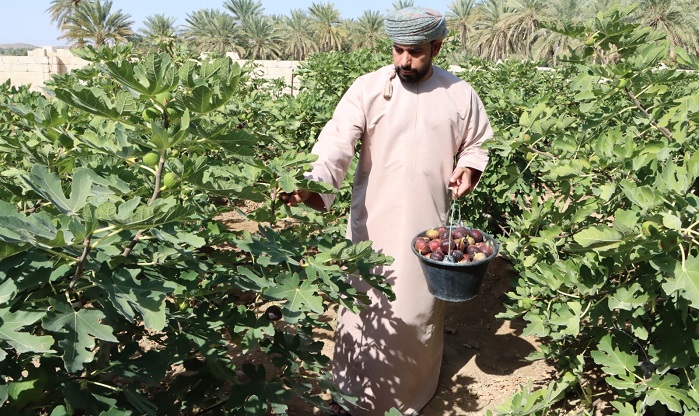
Ibri: Omani youth are increasingly investing their talents and capabilities into successful roles in managing, operating, and investing in local agricultural crops with commercial viability, thereby securing sustainable economic returns. Among these successful initiatives, an Omani youth, Abdulrahman Hamoud Al Kalbani, from the town of Al Houmaniya in the Wilayat of Ibri, has managed to transform his passion for agriculture into a productive enterprise specialising in fig cultivation.
Abdulrahman Al Kalbani stated that his agricultural project began in 2023 as a personal experiment driven by an interest in growing fig trees due to their high nutritional and economic value. He noted that he initially planted approximately 300 trees on his farm in the village of Al Houmaniya, achieving encouraging results in the first production season that exceeded expectations, which provided a strong incentive to continue expansion and development.
He added that the success of the first phase led to the planting of an additional 300 trees in another field, accompanied by a noticeable improvement in crop quality. This gradual expansion has continued until the number of currently planted fig trees reached approximately 1,200, distributed over an area of nearly four acres.
He explained that continuous care for the trees has contributed to raising production levels, with daily production during the harvest season reaching more than 100 kilograms of figs. This success is attributed to the adoption of modern agricultural methods, including regular irrigation, organic fertilization, and periodic pruning, in addition to washing the trees approximately every two weeks to ensure healthy growth and high productivity.
Regarding marketing, Al Kalbani indicated that the product is marketed locally by packaging it in plastic containers designated for sale and distributing them to commercial shops and retail outlets within the Wilayat. He emphasised his ongoing efforts to develop display and packaging methods in line with market requirements and consumer needs.
Concerning the varieties grown, Al Kalbani mentioned that he relies on two main types: "Brown Turkey" and "Deanna," due to their abundant production, high quality, and relative resistance to pests.
He is also currently experimenting with ten other varieties to select the most suitable for future expansion.
He stressed that his future ambitions include creating added value for the fig crop through private sector adoption of downstream processing projects, such as the production of fig jam or dried figs. Such initiatives would contribute to absorbing surplus production, opening new marketing horizons, and increasing the economic return for farmers.