Sunday 15 / February / 2026
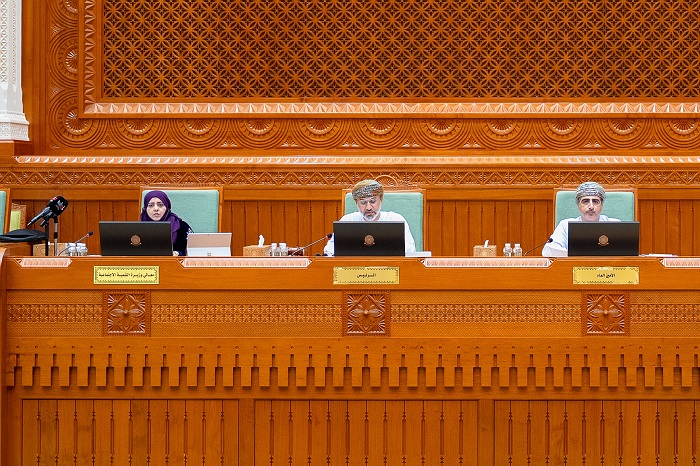
Muscat: The Shura Council convened on Sunday to discuss the statement delivered by Dr. Laila Ahmed Al-Najjar, Minister of Social Development. The session was chaired by Khalid Hilal Al Maawali, Chairman of the Shura Council, members of the Council and Ahmed Mohammed Al Nadabi, Secretary-General of the Council.
Discussions focused on key areas of social development, particularly family protection and cohesion, care for the most vulnerable groups, women’s empowerment, support for persons with disabilities, elderly care, preventive and social programs, relevant legislation, and the Ministry’s efforts to establish a comprehensive and sustainable social protection system.
In his opening remarks, the Chairman welcomed the Minister of Social Development, underscoring the importance of cooperation between the legislative institution and government bodies in supporting development pathways and achieving national objectives.
He emphasised the vital role of Council Members in presenting views and proposals aligned with national priorities, contributing to unified efforts and the optimal utilisation of resources in service of the public interest.
Minister’s address
In her address before the Council, Dr. Laila Ahmed Al-Najjar outlined the Ministry’s current priorities, affirming that its work is guided by a national vision that places people at the heart of development policies. She stressed that family cohesion and social stability constitute the cornerstone of sustainable development.
She highlighted the Ministry’s strategic shift from traditional welfare models to empowerment- and sustainability-based approaches, aimed at fostering self- reliance and transforming beneficiaries into active partners in economic and social development.
She noted the Ministry’s special focus on family protection through the enhancement of family counseling services, regulation of family and psychological counseling professions, and the launch of national initiatives addressing mental health, community prevention, and capacity building.
The Minister further emphasised the development of an integrated social safety system, including women-focused programmes, inclusive services for persons with disabilities, improved elderly care services, legislative modernisation, institutional integration with the Social Protection Fund, and accelerated digital transformation to enhance governance, efficiency, and evidence-based planning.
She concluded by affirming that social work is a shared national responsibility involving government institutions, civil society, and the private sector, reiterating the Ministry’s commitment to advancing policies in line with Oman Vision 2040 and promoting human dignity and quality of life in the Sultanate of Oman.
Key Highlights from the Ministry’s Statement The Ministry’s statement addressed six main pillars:
1. Juvenile Delinquency and At-Risk Youth
The Ministry reported a noticeable increase in juvenile delinquency cases over the past four years: 282 cases in 2021, 419 cases in 2022, 455 cases in 2023, 563 cases in 2024
This represents an increase of 281 cases over four years—nearly double the 2021 figure.
In 2023, theft cases topped the list (84 cases), followed by violence against children (41 cases), assault (36 cases), and information technology-related offenses (16 cases).
The Ministry continues to implement preventive programmes in schools and communities, alongside post-care systems aimed at reintegrating juveniles into society and reducing recidivism.
2.Family Development and Community Protection
The Ministry emphasised a preventive and capacity-building approach to strengthening family cohesion.
It implemented awareness programmes, updated regulatory frameworks for temporary care institutions, and expanded psychological and social support services for vulnerable groups.
In marital counseling, 1,901 beneficiaries participated in the “Edaad” (Marriage Preparation) programme in 2024. 56 certified trainers now deliver marital counselling programmes across Oman’s governorates.
3.Social Protection and Economic Empowerment
The statement highlighted the scale of social support interventions: 74,486 social security cases in 2022 (OMR 117,380,258), 79,597 cases in 2023 (OMR 122,178,206), 98,908 beneficiaries of social assistance in 2024 (OMR 10,167,127), 66,004 beneficiaries by June 2025 (OMR 6,873,264).
Additionally, 10,040 productive families were economically empowered between 2022 and mid-2025 through training, financial support, and sustainability-focused follow-up programmes.
4.Monitoring Social Phenomena
Between 2023 and mid-2025, the Ministry conducted approximately 20 specialised studies addressing issues related to children, women, the elderly, persons with disabilities, volunteerism, and technological developments in social sectors.
5.Legislative and Regulatory Developments
The Ministry has prioritised legislative modernization, including: Issuing a Governance Guide for Civil Associations (Ministerial Decision No.299/2024). Issuing regulations governing public fundraising (Ministerial Decision No. 336/2024).
Reviewing the Associations Law in preparation for a modern Civil Society Organizations Law.
Updating juvenile justice legislation to strengthen rehabilitative approaches. Implementing the new Law on the Rights of Persons with Disabilities (Royal Decree No. 92/2025).6.
Institutional Restructuring and Social Protection Integration The Ministry reaffirmed its commitment to building a comprehensive social protection framework in coordination with the Social Protection Fund (established by Royal Decree No. 33/2021).The integrated system aims to ensure fair and efficient support delivery, while gradually shifting from direct assistance to empowerment-based models aligned with Oman Vision 2040.
Council Members’ Interventions Council Members raised several key issues:
Updates on amendments to the Social Assistance Regulation and the timeline for its enforcement.
Delays in disbursing medical devices to eligible beneficiaries.
The existence of low-income citizens outside the social protection umbrella.
Strengthening coordination with the Ministry of Labour to increase employment rates among beneficiaries.
Establishing a National Social Research Center.
Creating an integrated digital database to monitor early indicators of juvenile delinquency.
Allocating emergency financial provisions for urgent social cases.
Evaluating the impact of women’s empowerment programs.
Developing specialized national cadres in special education to support Wafa Social Centers.
Enhancing media awareness campaigns on juvenile delinquency prevention.
Establishing additional headquarters for the Omani Women’s Association across various governorates.
Members also expressed concerns regarding recent decisions affecting charitable teams and called for clarification of their implications.