Wednesday 26 / August / 2026
Muscat: The UNESCO-Sultan Haitham Prize for the Safeguarding of Intangible Cultural Heritage derives its significance from being both an invocation and an essential expression of human intellectual consciousness. It serves as a tool that consolidates the fundamental principles of human thought and creativity, and acts as a genuine driver for preserving the essence of human history.
The prize reflects the deep commitment of His Majesty Sultan Haitham bin Tarik to cultural heritage and recognises its importance as a symbol and reference point of human identity.
In its intrinsic value, the prize stands as one of the world’s most significant global initiatives supporting outstanding cultural contributions at the international level. It will honour individuals, institutions, organisations, centres, scientific and cultural institutes, and governmental and non-governmental bodies working in the field of cultural and human heritage. The prize will acknowledge their efforts in intangible cultural heritage while advancing Oman’s cultural mission on the international stage.
The prize will highlight Oman’s civilisational and cultural role in the field of intangible cultural heritage, foster international awareness of Oman’s cultural standing and its engagement in cultural dialogue, and champion the first international initiative focused on intangible cultural heritage among UNESCO’s prizes to be led by the Sultanate of Oman. It will also enrich sustainable development projects in this domain, based on competition among institutions working in the field, thereby enhancing innovation and creativity.
Furthermore, the prize will support scientific research, strengthen educational dimensions that raise awareness of the importance of intangible cultural heritage for successive generations, and ensure the sustainability and intergenerational transmission of human creativity.
Dr. Aisha Hamad Al Darmaki, a member of the State Council, said: "The Sultanate of Oman has long worked to preserve and safeguard its cultural heritage, for it represents not only its civilisational history but also its present and future — the foundation from which human development springs, through which its modern principles are reinforced, and by which it maintains its openness to a changing world. Cultural heritage in Oman is a historical force, a civilisational glory and an intellectual depth upon which social development is built, and through which modern cultural patterns evolve, serving as the nation’s window to the world."
She added: "Because cultural heritage is a resource for sustainable development and an authentic reservoir of creativity and innovation — the very drivers of the future — the establishment of a cultural heritage prize at UNESCO bearing the name of His Majesty Sultan Haitham bin Tarik reflects Oman’s profound understanding and insightful awareness. This is evident in Oman’s far‑sighted vision of the importance of cultural heritage for nations and the necessity of preserving and protecting it, as well as the contribution heritage makes to human development, the potential it offers to knowledge and technology sectors, and the exceptional advantages it provides to promising fields such as tourism and creative industries."
She affirmed that the establishment of the prize at this particular moment serves as Oman’s message to the world: an invitation to peace, understanding and partnership. "Cultural heritage is always described as 'human' because it expresses humanity’s thought and the depth of its existence in this world, symbolising a shared history and civilisation in which nations partake."
She noted that by founding the prize at a time filled with the noise of gunfire, bombardment and destruction in many parts of the world, Oman extends a clear invitation to return to a shared human history — one that represents the power of creativity, thought and the building of civilisations.
She also said that the Sultan Haitham Prize for Cultural Heritage provides a fertile environment for nations to safeguard their human heritage, and encourages researchers, practitioners and creators worldwide to actively contribute to collecting, studying and analysing their cultural heritage, while developing creative patterns and innovations that support sustainable development goals. "This prize is Oman’s gift to the world to safeguard human heritage, and its invitation to embrace that heritage as a message of peace and coexistence among nations."
Dr. Mahmoud bin Abdullah Al Abri, Secretary of the Oman National Commission for Education, Culture and Science, explained that UNESCO defines intangible cultural heritage as "the practices, representations, expressions, knowledge and skills – as well as the instruments, objects, artefacts and cultural spaces associated therewith – that communities, groups and, in some cases, individuals recognise as part of their cultural heritage." It is also known as living heritage. Oman acceded to UNESCO’s 2003 Convention for the Safeguarding of the Intangible Cultural Heritage in 2005, aiming to strengthen cultural identity, protect folk arts, traditional crafts and associated knowledge from extinction, ensure their sustainability for future generations, and enhance their international presence by registering Omani heritage elements on UNESCO’s lists — in line with Oman Vision 2040 and the Sultanate of Oman’s active role in regional and international cooperation on intangible cultural heritage.
Oman’s efforts have been consistent with this approach, he said, through the enactment and updating of cultural heritage legislation and the preparation of a national cultural strategy that places great importance on safeguarding intangible heritage.
Regarding the UNESCO‑Sultan Haitham Prize for the Safeguarding of Intangible Cultural Heritage, Dr. Al Abri said it holds profound strategic importance by contributing effectively to UNESCO’s programmes and aligning them with the organisation’s global priorities. The prize observes gender equality and youth inclusion in all aspects, while effectively addressing UNESCO’s overarching priority on Africa by attracting high‑quality nomination files from the region, whilst maintaining balanced representation from all regions. It also highlights community efforts to safeguard heritage and reinforces UNESCO’s role in promoting cultural diversity, social cohesion, sustainable development and peace.
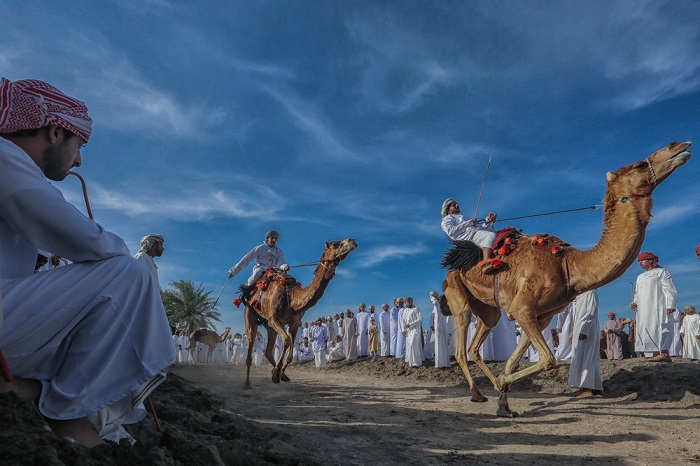
Dr. Al Abri noted that Oman has inscribed 17 cultural elements on UNESCO’s Representative List of the Intangible Cultural Heritage of Humanity: Al‑Bar'ah (2010), Al‑‘Azi (2012), Al‑Taghrood (2012), Al‑‘Ayala (2014), Al‑Razfa (2015), Cultural Spaces of the Majlis (2015), Arabic Coffee (2015), Horse and Camel Ardhah (2018), Date Palm and Associated Practices (2019), Camel Racing (2020), Arabic Calligraphy (2021), Alheda’a (Camel Call) (2022), The Dagger (Khanjar) (2022), Al‑Harees “traditional dish” (2023), Henna (2024), Al‑Bisht (2025) and Kohl (2025). In addition, the “Shabab Oman Vessel’s Programme for Peace and Sustainable Cultural Dialogue” was inscribed on the Register of Good Safeguarding Practices in 2024.
Oman ranks second among Arab states for the number of files inscribed on UNESCO’s Representative List, he said. In 2023, Muscat hosted the review of the Arab Strategy for the Safeguarding of Intangible Cultural Heritage under the Arab League Educational, Cultural and Scientific Organization (ALECSO), known as the “Muscat Declaration.” The strategy aims to strengthen Arab and Islamic cultural identity and ensure the preservation and safeguarding of intangible heritage.
The Sultanate of Oman’s ratification of the 2003 Convention for the Safeguarding of Intangible Cultural Heritage places it among the first states to accede to the treaty. The Ministry of Culture, Sports and Youth is responsible for implementing the Convention and registering intangible cultural heritage elements across its three lists: the Representative List of the Intangible Cultural Heritage of Humanity, the List of Intangible Cultural Heritage in Need of Urgent Safeguarding, and the Register of Good Safeguarding Practices — which includes programmes, projects and activities that embody the Convention’s principles and objectives.
Since acceding to the Convention, Oman has achieved several milestones, including membership on the Convention’s Intergovernmental Committee from 2008 to 2012, membership on the Evaluation Body for nomination files from 2018 to 2021, the inscription of 18 intangible cultural heritage elements through national and joint files, and the establishment of a national inventory covering eight domains: folk arts, customs and traditions, traditional crafts, traditional cuisine, folk tales and stories, mud‑brick architecture, traditional games and traditional attire. Oman has also organised local capacity‑building programmes for researchers and cultural professionals, along with several scientific workshops to engage with practitioners of intangible cultural heritage elements.