Saturday 06 / June / 2026
Muscat: The Global SWF Foundation has commended the Oman Investment Authority (OIA) for its success in improving the performance of government-owned companies, recycling state assets, and attracting foreign capital and expertise to strategic sectors that support the goals of Oman Vision 2040. The foundation said the authority has emerged as a distinctive model among sovereign wealth funds by combining state-owned enterprise reform with investment promotion and economic development.
In its latest report, Global SWF stated that the OIA’s performance in 2025 reflects the success of the sovereign investment structure adopted by the Sultanate of Oman after 2020, particularly the transfer of government companies under the authority’s management. The report noted that the authority has focused on enhancing the profitability and operational efficiency of these companies while maintaining state ownership in strategic sectors.
The foundation observed that, unlike some of the region’s largest sovereign wealth funds, the OIA has developed a model that integrates government company reform, reinvestment, strategic foreign partnerships, selective divestments and support for local economic development. This approach has enabled the authority to reshape state ownership structures, create employment opportunities, strengthen local supply chains and attract international investors and expertise.
According to the report, the OIA has used public offerings, direct sales and strategic partnerships as tools to improve operational discipline within government assets while redirecting proceeds towards sectors with greater strategic importance and stronger growth potential.
One of the most significant examples highlighted by Global SWF is the transformation of OQ Group. Prior to its transfer to the OIA in 2020, the group faced mounting operational challenges and financial pressures linked to major expansion projects and rising debt levels. Following its integration into the authority’s portfolio, a comprehensive transformation programme was launched, focusing on updating corporate strategy, strengthening integration across business units, restructuring capital and debt, and recycling capital through asset sales and public offerings on the Muscat Stock Exchange.
As a result, OQ succeeded in reducing total debt by 48 percent, from OMR5 billion to OMR2.7 billion, while releasing OMR2.2 billion in government guarantees. The group also improved its net debt-to-operating-profit ratio from 8.6 times to 0.6 times by 2025 and secured investment-grade credit ratings from Fitch and Standard & Poor’s.
The report also highlighted the turnaround of OQ Refineries and Petrochemicals Company, which achieved its first profits since its establishment more than two decades ago. The company had previously struggled with operational inefficiencies, market volatility and significant financial obligations. Under the authority’s oversight, a strategic transformation programme extending to 2030 was launched to improve operational efficiency, strengthen asset reliability, reduce costs and restructure liabilities.
Between 2021 and 2025, the company generated cumulative profits of OMR474 million and increased production capacity from 80 million barrels to 93 million barrels. It also began implementing plans to repay outstanding loans worth OMR2.7 billion.
In the food security sector, the authority oversaw the restructuring of the Oman Food Investment Holding Company “Nataj” and the Oman Fisheries Development Company. Both entities faced challenges associated with asset expansion and business diversification, prompting the need for stronger integration, improved operational efficiency and better utilization of resources. The restructuring process included merging the two companies into a unified entity, reorganizing executive management and boards, restructuring loans, strengthening risk management systems and securing strategic partnerships for project development and operations.
These measures delivered significant results. Revenues from the fisheries portfolio increased by more than 93 percent, while revenues from Nataj assets grew by more than 23 percent. Portfolio companies, including Mazoon Dairy and Al Wusta Fisheries Industries, achieved performance improvements exceeding 100 percent, reflecting the effectiveness of the integration and restructuring efforts.
Mazoon Dairy was cited as another successful example of corporate transformation. The company had been affected by operational and financial challenges, compounded by supply-chain disruptions during the COVID-19 pandemic.
In response, the OIA carried out a comprehensive review of operations across the entire value chain and appointed a new management team to implement an extensive transformation programme focused on product development, distribution expansion and operational efficiency. The company reached financial break-even in 2024 and recorded operating profits of OMR 3 million, while revenues rose by 15 percent between 2024 and 2025 due to stronger sales and export growth.
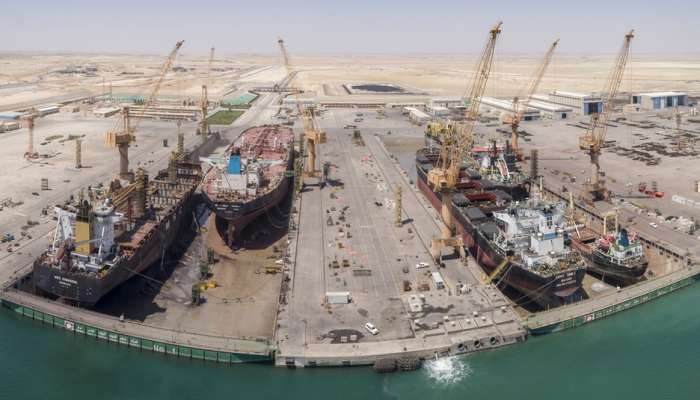
The authority’s efforts also extended to the maritime sector through Asyad Drydock Company. The company had long faced intense competition in ship repair and marine services and relied heavily on the oil and gas tanker segment.
These pressures were intensified by the global disruption caused by the COVID-19 pandemic. To strengthen the company’s position, the OIA focused on improving operational efficiency, upgrading infrastructure, adopting advanced technologies, diversifying revenue streams and expanding into new market segments.
The strategy delivered strong results between 2021 and 2025. Asyad Drydock recorded a compound annual growth rate of 65.9 percent in net profits and 16.2 percent in revenues. The company completed 258 projects in 2025, representing an 11 percent increase compared to 2024, while operational productivity improved by 22 percent.
In the events and business tourism sector, the Oman Convention and Exhibition Centre emerged as another example of successful transformation. The centre had faced challenges associated with fluctuations in the events market and reliance on government support during its early years. External geopolitical and regional developments also affected the flow of conferences and events, placing pressure on revenues.
To address these challenges, efforts were directed towards diversifying income sources, increasing reliance on operating revenues, attracting international events and enhancing services. These initiatives enabled the centre to achieve its first operating profit in 2024 since opening in 2016. Annual income increased from approximately OMR 3.4 million in 2022 to more than OMR 7.6 million in 2025, while dependence on government support declined.
Global SWF further noted that the OIA remains strongly focused on supporting the domestic economy, with nearly two-thirds of its assets invested within Oman. International investments account for 19 percent in North America, 9 percent in Europe, 4 percent in Asia-Pacific and 7 percent in other markets. The report described this allocation as typical of a strategic sovereign fund, balancing domestic development priorities with global investment opportunities that generate returns for reinvestment and government support.
The report also highlighted the authority’s evolving approach to international partnerships. Rather than focusing solely on financial returns, the OIA increasingly uses strategic partnerships to attract technologies, expertise and industrial capabilities that can strengthen key sectors of the Omani economy. Priority sectors include food security, healthcare, logistics, energy, mining, manufacturing and information and communications technology.
Global SWF pointed to partnerships involving countries such as Kazakhstan, Turkey, Jordan and Azerbaijan as examples of this strategy. The report noted that the authority is moving towards more flexible forms of cooperation that can evolve into investment platforms, joint ventures or specialized funds depending on available opportunities.
The foundation also highlighted the role of the Oman Future Fund, which has become a key vehicle for attracting investment into priority sectors. By the end of 2025, the fund had received 986 investment applications and approved 186 projects with a combined value of OMR 1.72 billion, including OMR 743 million in foreign investment. The fund focuses on sectors such as energy, logistics, food, technology, manufacturing, healthcare and basic services.
According to the report, the authority follows an “Omani dimension” principle that links foreign investment to local economic needs by encouraging the transfer of technology, industrial capabilities and expertise into the Sultanate. Investments through the Omani-Turkish joint fund, for example, are expected to support the localization of industrial technologies and strengthen domestic production capabilities.
The report further emphasized the importance of the OIA’s divestment programme, describing it as a central pillar of the authority’s strategy. Through public offerings, direct sales and strategic partnerships, the programme aims to improve operational performance, attract foreign capital and redeploy proceeds into sectors with higher strategic value and stronger growth prospects.
Global SWF also praised the authority’s efforts to maximise local content. Spending on small and medium enterprises reached OMR 278 million in 2025, including OMR 186.4 million directed to holders of the Riyada card. SMEs accounted for 19.9 percent of total supply-chain spending. The report noted that initiatives such as the “Fursah” platform provide local suppliers with early access to tenders issued by the authority and its portfolio companies, helping to strengthen local participation in economic activity.
Concluding its assessment, Global SWF commended the Oman Investment Authority’s strategy of improving the performance of state assets, implementing targeted divestments, recycling capital into value-added investments, supporting local businesses and leveraging international partnerships to attract capital, expertise and technology to priority sectors. The foundation described the authority as an increasingly important instrument for advancing economic diversification and sustainable development in the Sultanate of Oman.