Thursday 18 / June / 2026
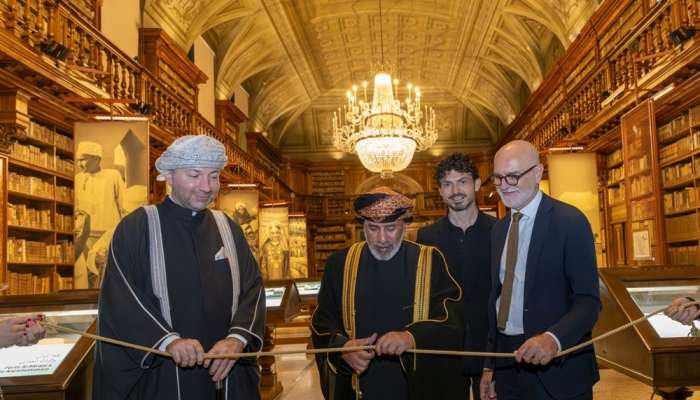
Milan — The National Museum today inaugurated its exhibition and Oman Day programme,Oman and Italy: Two Millennia of Cross-Civilisational Dialogueat the prestigious Pinacoteca di Brera in Milan, Italy.
The exhibition explores the enduring dialogue and deep historical ties that have connected Oman and Italy for nearly two millennia through vibrant networks of trade, knowledge, and cultural exchange. Drawing on archaeological discoveries, travel literature, cartography, and the arts, it traces a shared civilisational legacy across the Mediterranean and the Indian Ocean.
The exhibition is organized under the National Museum’s Oman Day initiative, which aims to showcase Oman’s civilisational, historical, cultural, and scientific heritage in leading international museums and cultural institutions, reaching diverse audiences around the world.
The opening ceremony was attended by HH Sayyid Nizar bin Al Julanda Al Said, Ambassador of the Sultanate of Oman to the Republic of Italy, and Jamal bin Hassan Al Moosawi, Secretary General of the National Museum, together with a number of officials and cultural and museum professionals from Italy.
Al Moosawi stated: “The National Museum is honoured to present this exhibition within the confines of the momentous Braidense National Library, the first such museum initiative by the Sultanate of Oman in the Italian Republic. Throughout the past centuries, the noblest of Italian minds have played a key role in the revelation of the primary characters of Oman, its archaeology, architectural heritage, customs and traditions, geography, geology, fauna and flora, and its government. Some notable Italians have left their particular mark on our history too”.
He added: “This exhibition focuses on the archeological legacy, publications of anthologies of travelogues, accounts which give an overview of documents and books, cartography, and the arts. Likewise, common threads that attest to the bonds of our cultures are explored and highlighted, including the Aflaj water management system, known in Sicily by its Arabic nameQanat, the ritualistic significance of theal Luban(frankincense) in the mosque and the church liturgy respectively. Another point of contact of the Imperial epochs of Oman and Italy was the lands of the African continent”.
On his turn, HH Sayyid Nizar said: “It is a source of immense pleasure that the Omani exhibition, titled “Oman and Italy: Two Millennia of Cross-Civilisational Dialogue”, is being hosted the Grande Brera in the City of Milan, Italian Republic. This exhibition showcases a curated selection of collections from the National Museum of the Sultanate of Oman, which chronicle the deep-rooted relationships and civilizational exchange spanning two thousand years between Oman and Italy. It brilliantly highlights the cultural and historical richness of both civilisations as manifested in archaeology, travel literature, cartography and the arts”.
He added: “The Civilisational connections forged by the Sultanate of Oman across the sea of Oman, the Indian ocean and onward to the Mediterranean Sea – alongside the historic Frankincense Route – have long served as a conduct for intellectual enrichment and cultural heritage for both the Omani and Italian nations. This enduring legacy continues to thrive today through the robust Omani-Italian relations across all fields. The exhibition before us stands as a testament to the strategic depth of the bonds shared between our two friendly nations and peoples”.
Meanwhile, Angelo Crespi, Direttore Generale of Pinacoteca di Brera said: “Between Grande Brera and the National Museum of Oman, a profound scientific and cultural collaboration has been underway for the past two years. It is within this framework that the idea for this exhibition was conceived: not only to celebrate two millennia of dialogue between our cultures, but also to define the meaning of a living heritage that continues to look towards the future.”
He added: “In the spirit of cultural cooperation between our two countries, highlighted during the official visit of the Italian Prime Minister to Oman and shared by His Majesty the Sultan, the exhibitionOman and Italy: Two Millennia of Cross-Civilisational Dialoguebears witness to the multiplicity of artistic languages that have given value, including through customs and traditions, to the significance of the historical bond between Oman and Italy.”
He noted that the initiative aims to offer the public an opportunity to gain a deeper understanding of the history, heritage, and cultural identity of the Sultanate of Oman, while highlighting its role as a meeting place of civilizations between the Arabian Peninsula, the Mediterranean, and our country.
He furthered: “This initiative aims to offer the public an opportunity to gain deeper insight into the history, heritage, and cultural identity of the Sultanate of Oman, while highlighting its role as a crossroads of civilizations connecting the Arabian Peninsula, the Mediterranean, and our own country.”
The exhibition traces cultural exchange between Oman and Italy through a series of interconnected geographical and intellectual themes, beginning in classical antiquity, when Oman served as a strategic hub within maritime trade networks and along the Frankincense Route, as documented by ancient writers including Strabo, Pliny the Elder, and Ptolemy.
Among the exhibition’s most significant artefacts are objects that place Oman’s Iron Age artistic and religious heritage in dialogue with the classical Mediterranean world. These include a bronzeSnake figurediscovered at Saih al-Qa’a in the Wilayat of Al Hamra and pottery fragments from the Sallut archaeological site, displayed alongside two snake-shaped vessel handles of Roman Italian origin uncovered on Masirah Island. A Plaque with Old South Arabian (Hadhramitic) Inscription from the ancient port of Sumhuram further underscores the exalted status of frankincense in the ancient world.
The exhibition also draws comparisons between Oman’s afalaj irrigation systems and analogous water channels introduced to Sicily during the Arab-Islamic period, highlighted through the manuscript(al-azīzi falaj log)by : Rabi’ah bin Majid al-Kindi, dated 1891.
In the realm of intellectual and scientific exchange, the exhibition features the manuscriptA Poem on the Anatomy of the Eye (Qasīdafi Tashrīh Al Ayn)Rashid bin Umayra ar-Rustaqi (1887);Il Haggnell’Asia(The Hajj in Asia), the travel account of Italian physician Angelo Legrenzi (1705); andAn Nuniyah Al Kubrah (The Major Noon)by the celebrated Omani navigator Ahmad bin Majid Al Saadi, inscribed on UNESCO’s Memory of the World Register in 2025 as a landmark testament to Oman’s contribution to maritime science.
The exhibition further explores Oman’s early embrace of Islam and its flourishing tradition of jurisprudential scholarship as a centre of Ibadi thought. Rare manuscripts on display includeDigest of Laws (Bayan Ash Shar')andDictionary of Islamic Law” (Qamūs Ash Sharī'ah), printed in Zanzibar, alongside illuminated Qur’anic manuscripts and a Swahili translation of the meanings of the Holy Qur’an. This intellectual heritage is placed in dialogue with Western engagement in Qur’anic studies through a European printed edition of the complete Qur’an translated by Ludovico Marracci and published in Padua in the eighteenth century.
Shared architectural heritage is highlighted through the historical presence of the Augustinian Order in Muscat, represented today by Bait al-Greiza, now part of the National Museum, and through al-Mirani Fort, which reflects the layered military and engineering influences of Oman, Italy, and Portugal.
Venice’s connections with Oman are explored through the accounts of travellers such as Marco Polo, who documented Omani ports, as well as through ongoing numismatic evidence represented by Venetian zecchino and ducat gold coins discovered in A’Seeb and Al Wafi. A more contemporary artistic link is embodied in an Omani glass vase crafted in the Venini style on the island of Murano in 1994.
The exhibition also presents a rare selection of historic maps from the personal collection of the late Sultan Qaboos bin Said, including sixteenth-century copper engravings produced in Venice.
Further illustrating the depth of historical interaction, the exhibition features accounts by travellers from the Papal States, including Ludovico di Varthema, Pietro della Valle, and Moricci, who described the strategic ports of Muscat, Sohar, and Hormuz as maritime crossroads linking Europe with the Indian Ocean. Italian Orientalist art is represented through watercolours by Giuseppe Signorini and Gustavo Simoni.
The exhibition concludes by examining Somalia as a shared maritime and cultural meeting ground where Omani influence and the architectural development of Mogadishu intersected with later Italian modernisation. This theme is represented by an architectural fragment with arabesque motif element from Bait al-Greiza in Mogadishu, dating to 1872.
The Pinacoteca di Brera in Milan is an autonomous state museum with general executive status. It comprises the Pinacoteca (Art Gallery), the Biblioteca Nazionale Braidense (National Library), Palazzo Citterio, and multimedia spaces. The institution enjoys full administrative, and financial autonomy under the supervision of the Minister of Cultural Heritage to establish international partnerships and attract institutional support.