Wednesday 28 / October / 2026
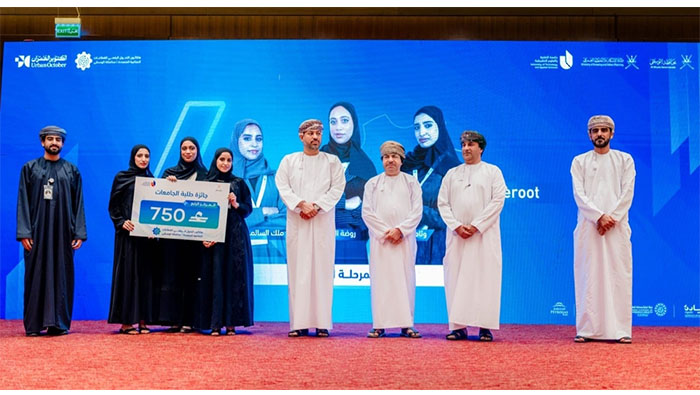
Al Musannah: Three projects from the University of Technology and Applied Sciences (UTAS) in Al Musannah, South Al Batinah Governorate, won at the Digital Transformation Hackathon for Multi-Industrial Sectors 2026.
The hackathon highlights the University's role in cultivating a culture of innovation and scientific research, as well as empowering students and researchers to develop applicable ideas and solutions. This enhances the integration between knowledge and technology and supports the targets of "Oman Vision 2040" in digital transformation and sustainable development.
Students from UTAS Al Musannah achieved an outstanding milestone in the hackathon, with the "Sibar" project winning first place—with a team comprising Mawaddah Al Rahbi, Inas Ibrahim Al Balushi, and Rawan Sulaiman Al Wahaibi—and the "Blue Root" project securing fourth place in the undergraduate student track—with a team including Malak Ghalib Al Salmi, Wiam Sulaiman Al Dahmani, Rauda Ali Al Hinai, and Firas Said Al Shahoumi.
Meanwhile, the "Mizan" project clinched first place in the postgraduate student track, featuring Mi’ad Ahmed Al Maamari and Saleh Humaid Al Shuraiqi. These results reflect the growing capacity of students to utilise modern technologies in innovating digital solutions that respond to real-world challenges and keep pace with the needs of economic sectors.
Dr. Khalifa Salim Al Hatmi, Deputy Assistant Vice Chancellor for Postgraduate Studies, Scientific Research, and Innovation at UTAS Al Musannah, stated in a statement to Oman News Agency (ONA) that the hackathon aims to enhance integration between academic knowledge and the needs of economic sectors, as well as encourage the development of testable and applicable digital projects, thereby supporting digital transformation and economic development. He noted that the teams' first-place wins in the digital transformation hackathon reflect student efforts and their ability to provide innovative solutions meeting the governorate's needs, praising the efforts of faculty members in supporting them.
He added that the hackathon saw the participation of 128 teams that presented digital solutions across various sectors, pointing out that the quality of ideas, their applicability, and their expected impact on the governorate were among the main evaluation criteria. He emphasised that the hackathon serves as a platform to support student innovation and enhance partnership between the university, society, and the public and private sectors, expressing hope that outstanding projects will be converted into practical initiatives contributing to development and digital transformation in the governorate.