Thursday 29 / October / 2026
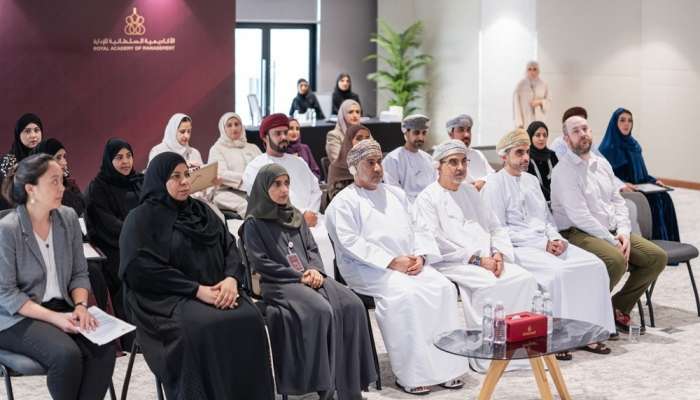
Muscat: The Royal Academy of Management (RAM) has concluded the Public Policy Design and Implementation Programme, delivered in collaboration with King’s College London.
This is done following an intensive learning journey designed to strengthen the capabilities of public sector leaders to translate national priorities into effective policies and measurable outcomes.
The programme brought together30 department directors and section heads from ministries and government institutions, equipping them with the analytical, strategic and practical tools required to navigate increasingly complex policy environments, make informed decisions based on data and evidence, and assess the effectiveness and impact of public policy.
The programme focused on a critical dimension of modern government: moving from policy intent and strategic direction to effective implementation and tangible results.
Dr Ali Qassim Al Lawati, President of the Royal Academy of Management, said that RAM’s collaboration with King’s College London provided participants with access to international expertise across the public policy cycle, while ensuring that global approaches were considered within Oman’s national context.
He added that the programme’s focus on artificial intelligence and its role in government decision-making reflects the growing importance of equipping public sector leaders to use emerging technologies to strengthen the quality, responsiveness and effectiveness of public policy.
The programme placed particular emphasis on department directors and section heads, recognising the critical role they play in connecting strategic direction with day-to-day implementation.
“These leaders operate at the point where strategy becomes execution,” Al Lawati said. “Their ability to analyse policy challenges, anticipate change, measure impact and engage effectively with stakeholders can determine whether a policy delivers its intended outcomes or remains confined to the document in which it was designed.”
Meanwhile, Dr Ahmed Al Lawati, Programme Supervisor, said the learning journey was structured around the fullpublic policy cycle, from policy diagnosis and design through to implementation, evaluation and impact assessment.
“The programme combined specialised learning modules with case studies, practical workshops andapplied policy projects, enabling participants to apply policy concepts to real challenges within their own professional environments,” he said.
“It also explored how artificial intelligence can support government decision-making and gave participants exposure to international practices and perspectives, strengthening their ability to apply what they learned within the Omani context.”
The curriculum included Policy Design for the Present, Policy Design for the Future, Public Policy in Action, Society and Artificial Intelligence, and Leadership. Participants also undertook practical learning activities and field visits at King’s College London in the United Kingdom, connecting academic perspectives with real-world policy challenges.
Throughout the programme, participants strengthened their ability to analyse the factors influencing policy implementation, assess outcomes against intended objectives, and communicate policy more effectively with stakeholders and society.
The learning experience also reinforced the importance of institutional collaboration in delivering better government performance and more effective public services.
The conclusion of the Public Policy Design and Implementation Programme marks another step in RAM’s efforts to develop national leadership capabilities through learning experiences that combine academic rigour with practical application.
By strengthening evidence-based policy design, implementation and impact measurement, Royal Academy of Management continues to support a more agile, innovative and future-ready public sector capable of translating the ambitions ofOman Vision 2040 into outcomes that create meaningful value for Oman and its society.